Guide to Nitrogen Purity

The atmosphere is 78% nitrogen gas. However, in industrial environments, purity is the variable that determines whether nitrogen improves performance or quietly drains operating budgets.
Nitrogen purity indicates the amount of oxygen and other trace gases remaining in the gas stream. If purity is too low, oxidation can damage metal surfaces, shorten product shelf life, and destabilize sensitive processes. If purity is too high, facilities consume excessive amounts of compressed air and electricity to achieve performance levels their applications do not require.
What Is Nitrogen Purity?
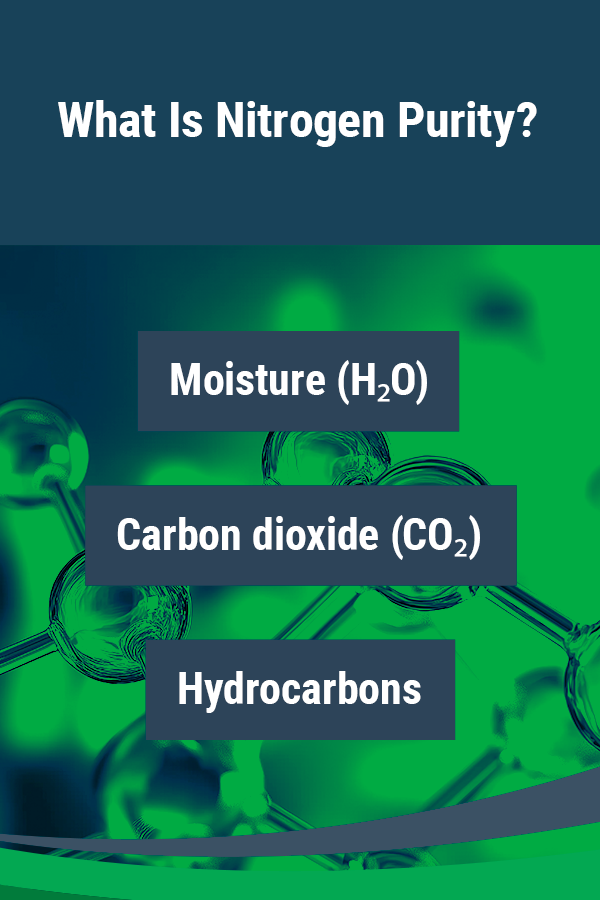
Nitrogen purity is the percentage of nitrogen (N₂) present in a gas stream relative to impurities. The primary impurity of concern is oxygen (O₂). Additional trace gases may include:
- Moisture (H₂O)
- Carbon dioxide (CO₂)
- Hydrocarbons
In most industrial applications, oxygen concentration is the critical factor because oxygen drives oxidation, combustion, corrosion, and chemical instability.
Percentage vs. Parts Per Million
Purity is expressed in two common formats, which are as follows:
- Percentage (%): Used for lower and mid-range purities such as 95%, 98%, or 99.9%.
- Parts per million (PPM): Used for high and ultra-high purities where oxygen must be reduced to very small concentrations.
For example:
- 1% oxygen equals 10,000 PPM
- 0.01% oxygen equals 100 PPM
- 0.001% oxygen equals 10 PPM
A nitrogen stream with 20 PPM oxygen corresponds to approximately 99.998% purity. The difference between 99.5% and 99.999% may appear small numerically. In practice, it represents a 500-fold reduction in oxygen concentration. In very high-purity environments, contamination levels may also be measured using parts per billion (PPB). While parts per million describes higher impurity levels, parts per billion is used for measuring extremely small trace gases. As nitrogen purity increases, the number of contaminants measured in PPM or PPB decreases, thereby increasing the overall nitrogen percentage.
Defining High and Low Purity
The basic breakdown of nitrogen purity percentages is:
- Low purity: 90%–99.9%
- High purity: 99.95% or greater
- Ultra-high purity (UHP): 99.999% or greater
Each incremental increase in purity requires a disproportionately greater amount of compressed air and energy.
Factors Impacting Nitrogen Purity
It is also important to understand that nitrogen purity can degrade after it leaves the generator. Even if nitrogen is produced at extremely high purity levels, the delivery system can affect the final purity reaching the application. Old piping, corrosion inside pipes, poorly installed fittings, or materials that are not rated for high-purity gas can introduce trace contaminants.
As nitrogen travels through the system, these contaminants may increase oxygen levels before the gas reaches its final application, such as a laser cutting machine or a food packaging system. This is why properly designed piping systems and high-quality installation are essential for maintaining nitrogen purity from generation to final use.
Nitrogen Purity Grades Explained
Different industries require different oxygen thresholds. Selecting the appropriate purity prevents both product defects and unnecessary cost.
Low and Commercial Grade — 90% to 99%
Low-purity nitrogen is typically used for:
- Fire prevention systems
- Basic inerting
- Reducing oxygen below combustion thresholds
In many inerting applications, reducing oxygen below 5%–10% is sufficient to prevent ignition.
Industrial Grade — 95% 99.6%
Industrial-grade nitrogen supports:
- Tire inflation
- Boiler layup
- Vessel purging
- Chemical blanketing
This range removes enough oxygen and moisture to prevent corrosion and oxidation in pipelines and tanks, while maintaining reasonable energy efficiency.
Food and Beverage Grade — 98% 99.9%
Food and beverage applications include:
- Modified atmosphere packaging (MAP)
- Coffee packaging
- Wine bottling
- Draft beer systems
Oxygen accelerates spoilage and degrades flavor. In MAP systems, even a 1% increase in oxygen concentration can shorten shelf life and impact color stability.
Many food processors must log oxygen levels to meet audit requirements, making purity monitoring essential.
High and Ultra-High Purity — 99.95% and Higher
One of the most commercially significant high-purity applications in industrial manufacturing is laser cutting.
In laser cutting, nitrogen functions as an assist gas, performing three critical roles:
- It shields the molten metal from atmospheric oxygen.
- It ejects molten material from the kerf.
- It stabilizes the cut edge temperature.
When oxygen contamination is present during cutting, the heat from the laser beam reacts with oxygen, forming iron oxide on carbon steel or oxide layers on stainless steel and aluminum.
Consequences include:
- Edge discoloration
- Increased dross formation
- Rough cut surfaces
- Larger heat-affected zones
- Secondary grinding or finishing operations
At 99.9% purity, 0.1% oxygen remains. That equals 1,000 PPM oxygen. For high-power fiber laser systems, the oxygen concentration can visibly degrade cut quality.
At 99.999% purity — more commonly referred to as “five-nines” nitrogen — oxygen drops to approximately 10 PPM. That significantly reduces oxidation and produces clean, bright cut edges, often eliminating the need for secondary processing. For metal fabrication facilities operating high-speed fiber lasers, nitrogen purity directly affects throughput, scrap rate, and finishing labor cost.
UHP nitrogen includes even higher purities, such as 99.9999% and 99.99999%, or six-nines and seven-nines nitrogen. Applications for these include semiconductor manufacturing and electronics.
Why Purity Level Matters
Selecting the correct purity is both a technical and financial decision.
Product Quality Impact
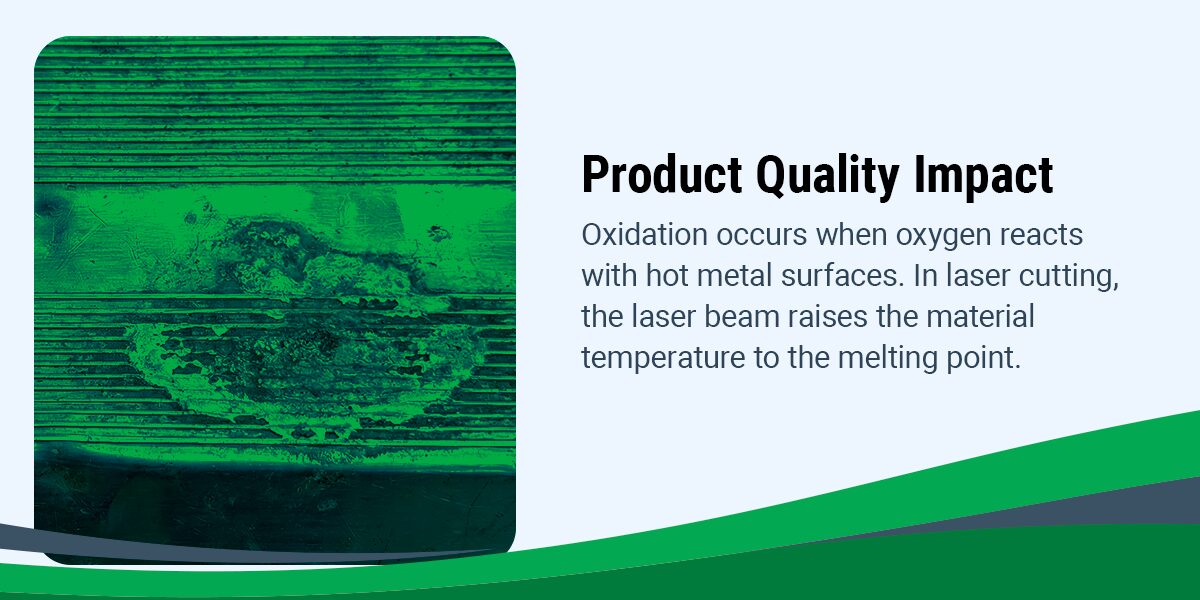
Oxidation occurs when oxygen reacts with hot metal surfaces. In laser cutting, the laser beam raises the material temperature to the melting point. If oxygen is present, it reacts with molten metal. That reaction forms oxides that alter edge chemistry and appearance.
Higher nitrogen purity reduces oxygen concentration, thereby reducing oxidation and secondary finishing. In food packaging, oxygen reacts with fats and pigments. That oxidation alters taste, color, and shelf life.
Purity is not theoretical. It is visible in the finished product quality.
The Role of Moisture and Dew Point Control
While oxygen concentration measures nitrogen purity, moisture content is also important in many industrial applications. Even small amounts of water vapor can cause corrosion, oxidation, and process instability.
In compressed air systems, moisture is measured using the dew point. A lower dew point means drier air and better protection against condensation inside pipes and equipment. Impacts of higher dew points in specific industrial contexts include:
- In laser-cutting environments, excessive moisture in the assist gas can affect cut consistency and cause surface imperfections.
- In food packaging, excess moisture can accelerate spoilage and degrade product quality.
- In pipeline blanketing or chemical storage, moisture mixed with oxygen raises the risk of corrosion.
For this reason, well-designed nitrogen systems include air dryers before the generator to make sure clean, dry compressed air reaches the membrane or PSA system. Controlling both oxygen concentration and moisture content helps maintain stable purity performance and long-term equipment reliability.
Safety and Process Stability
In oil and gas environments, nitrogen is used to reduce oxygen and maintain non-combustible atmospheres. If oxygen concentration rises above 5%–8%, ignition risk increases significantly. Maintaining target purity is therefore a safety requirement, not just a performance preference.
The Cost Curve of Increasing Purity
The relationship between nitrogen purity and energy consumption follows an exponential curve.
As purity increases:
- Oxygen removal may require longer adsorption cycles.
- More compressed air is consumed.
- Flow output decreases at higher purity.
- Compressor horsepower requirements increase.
This is where many facilities fall into the over-purity trap.
The Over-Purity Trap: A Real-World Scenario
Producing 95% nitrogen requires far less compressed air than producing 99.999%. The financial argument for on-site nitrogen generation depends heavily on matching the generator’s output to the actual process requirements.
Consider two facilities:
- Facility A purchases delivered liquid nitrogen at 99.999% purity.
- Facility B installs an on-site nitrogen generator configured for 98% purity, as required by the process.
Assume both facilities require 30,000 standard cubic feet per hour (SCFH) of nitrogen at application pressure. To produce 30,000 SCFH at 99.999% purity, a PSA system may require a significantly higher compressed air input than one producing 30,000 SCFH at 98%.
Higher purity requires:
- Larger compressors
- Increased horsepower
- Higher electrical demand
- Reduced output per unit of air
Facility A pays for five-nines purity continuously, regardless of the actual oxygen tolerance. Facility B produces only the purity required.
Producing 98% nitrogen requires substantially less compressed air and energy than producing 99.999%. Paying for ultra-high purity nitrogen when the process only requires mid-range purity is like buying race fuel for a delivery truck. The performance exceeds the need, but the cost remains high. Most facilities achieve return on investment in less than 18 months when transitioning from liquid nitrogen to properly sized on-site systems.
Nitrogen Purity by Industry
Different industries require vastly different nitrogen purity levels based on their specific process requirements. Below is a simplified breakdown of typical purity ranges by application.
| Industry | Typical Purity Range | Primary Function |
| Food and Beverage (MAP) | 98% – 99.9% | Prevent spoilage, extend shelf life, protect flavor |
| Laser Cutting | 99.9% – 99.999% | Prevent oxidation, ensure clean metal edges |
| Electronics & Semiconductor | 99.99% – 99.999%+ | Prevent microscopic defects |
| Oil and Gas & Chemical | 95% – 99% | Explosion prevention, pipeline purging |
| Industrial & Tire Inflation | 95% – 99% | Prevent corrosion, maintain pressure |
| Injection Molding | 98% – 99.5% | Prevent oxidation in gas-assist molding |
Laser cutting consistently demands UHP nitrogen due to finish sensitivity and part-quality requirements.
How Purity Affects Nitrogen Generator Selection
Understanding the relationship between purity requirements and generator technology helps optimize both capital expenditure and operational costs. Once purity requirements are defined, generator technology selection becomes straightforward.
Membrane Nitrogen Generators
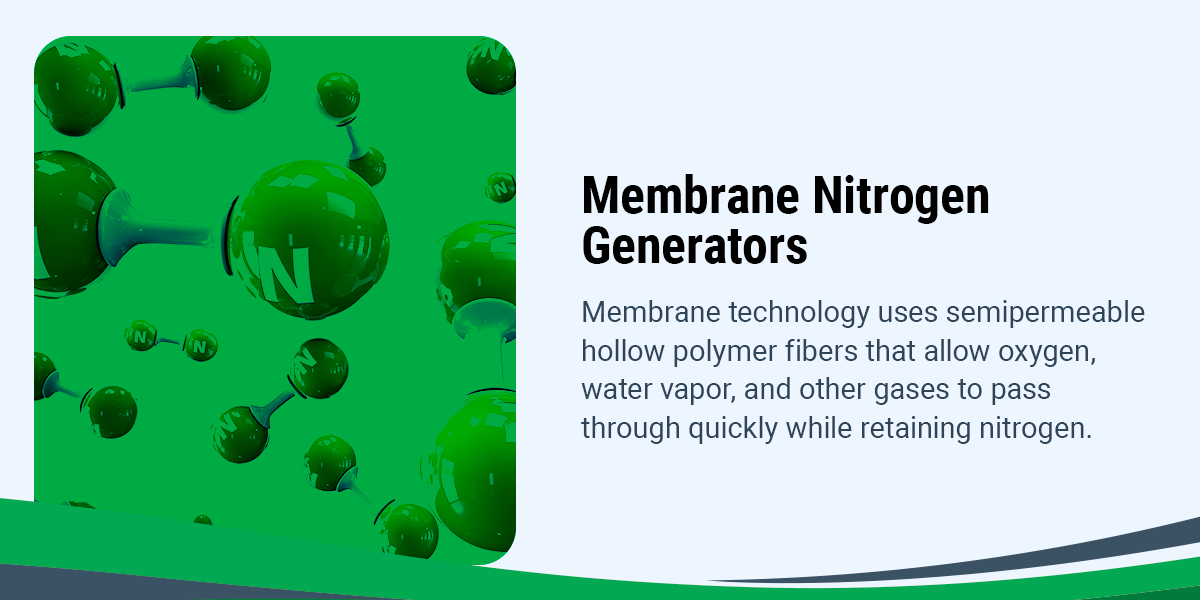
A membrane generator can produce lower purity nitrogen, between 95% and 99.9%. Membrane technology uses semipermeable hollow polymer fibers that allow oxygen, water vapor, and other gases to pass through quickly while retaining nitrogen. These systems offer simplicity, require no electricity beyond the air compressor, and operate quietly. Food packaging, adhesive blanketing, and pipeline purging represent ideal membrane applications.
Pressure Swing Adsorption Nitrogen Generators
Pressure swing adsorption (PSA) systems use carbon molecular sieve (CMS) beds to selectively adsorb oxygen molecules, providing PPM-level nitrogen control.
PSA systems are required for 99.9%–99.999% purity. They provide high-purity nitrogen by cycling adsorption beds under controlled pressure conditions.
Correct system sizing requires:
- SCFH at required purity
- Application pressure
- Duty cycle
- Compressor capacity
Oversizing the compressor due to over-specified purity increases capital cost and energy consumption.
Matching Flow and Purity
Higher purity settings reduce flow output. A generator set to 99.999% purity will produce significantly less SCFH than the same system operating at 95%. This occurs because the system must remove more oxygen molecules at higher purity levels, which requires longer adsorption cycles in PSA systems or slower permeation rates in membrane systems.
Proper sizing requires:
- Required SCFH at target purity
- Compressor capacity
- CMS sieve bed sizing
- Pressure requirements
Compressors often operate in tandem to maintain a stable compressed air supply during peak nitrogen demand.
Testing and Verification of Nitrogen Purity
Ensuring your nitrogen stream meets specifications requires continuous monitoring and periodic verification.
Oxygen Analyzers
Most nitrogen generators include built-in oxygen analyzers, either zirconium oxide sensors or electrochemical sensors, that monitor purity in real time. These analyzers continuously display oxygen content, allowing operators to verify that the generator maintains specified purity levels. If oxygen content drifts above the setpoint, the system automatically adjusts or triggers alarms to prevent out-of-specification nitrogen from entering the process.
Regular calibration of oxygen analyzers ensures long-term accuracy. Scheduled maintenance of sensors and filtration components prevents purity drift and protects overall system performance.
Regulatory Compliance and Documentation
Food packaging operations often face regulatory requirements for documented purity levels. Maintaining logs of purity measurements, calibration records, and system performance data supports both internal quality control and external audits.
Beyond the Technology — Why Liberty Systems?
Liberty Systems provides more than nitrogen equipment. Customers receive:
- Consultation from experienced Sales Engineers
- Up to three-year warranty coverage
- In-house system testing before shipment
- On-site installation training
- Ongoing service support
Our products are built and tested with rigorous quality management processes, risk management practices, and meticulous documentation, supported by our ISO 9001:2015-certified quality management system. Liberty Systems nitrogen is certified for food packaging in Canada by the Canadian Food Inspection Agency, demonstrating compliance with stringent food-safety standards.
Nitrogen generators do not create nitrogen. They provide it by separating nitrogen molecules from oxygen molecules using compressed air and adsorption technologies. The air separation process is engineered to precisely match your operational demands.
Selecting the Right Purity for Your Application
Selecting the right nitrogen purity represents more than a technical specification — it directly affects product quality, operational safety, and long-term costs. Over-specifying purity wastes energy and unnecessarily drives up expenses. Under-specifying purity compromises product quality and introduces safety risks.
Liberty Systems specializes in matching nitrogen generation systems to actual process requirements. Our Sales Engineers bring deep industry knowledge and technical expertise to every consultation, analyzing your purity needs, flow requirements, and operational constraints to design systems that optimize both performance and cost. We partner with 75% of laser manufacturers, giving us unparalleled insight into laser cutting applications and access to technical information that guides our system recommendations.
Contact Liberty Systems today to discuss your required purity, flow rate, and system configuration. Our Sales Engineers will help you avoid the over-purity trap and design a nitrogen generation solution that delivers exactly what your process needs.


Reviewed by